
There is a group of workers inside your organisation that almost no one is measuring. Microsoft’s 2026 Work Trend Index calls them “blocked agency”: people who have become genuinely skilled with AI, who understand what it can and cannot do, and who work in a company with no capacity to absorb any of it. They are roughly one in ten of everyone using AI at work.
That statistic should unsettle any executive team more than the familiar worry about employees who refuse to adopt. Resistance is a problem you know how to address. This is the opposite failure. Your people ran ahead, and the organisation could not follow.
Microsoft surveyed 20,000 AI users across ten markets and tested twenty-nine factors against whether people reported real value from AI. The organisational factors, culture, manager support and talent practices, accounted for roughly twice the impact of anything to do with the individual: 67% versus 32%. The single strongest signal was the organisation’s AI culture, about two and a half times stronger than the strongest individual factor. Only 19% of AI users sit in what Microsoft calls the Frontier, where individual capability and organisational readiness reinforce each other.
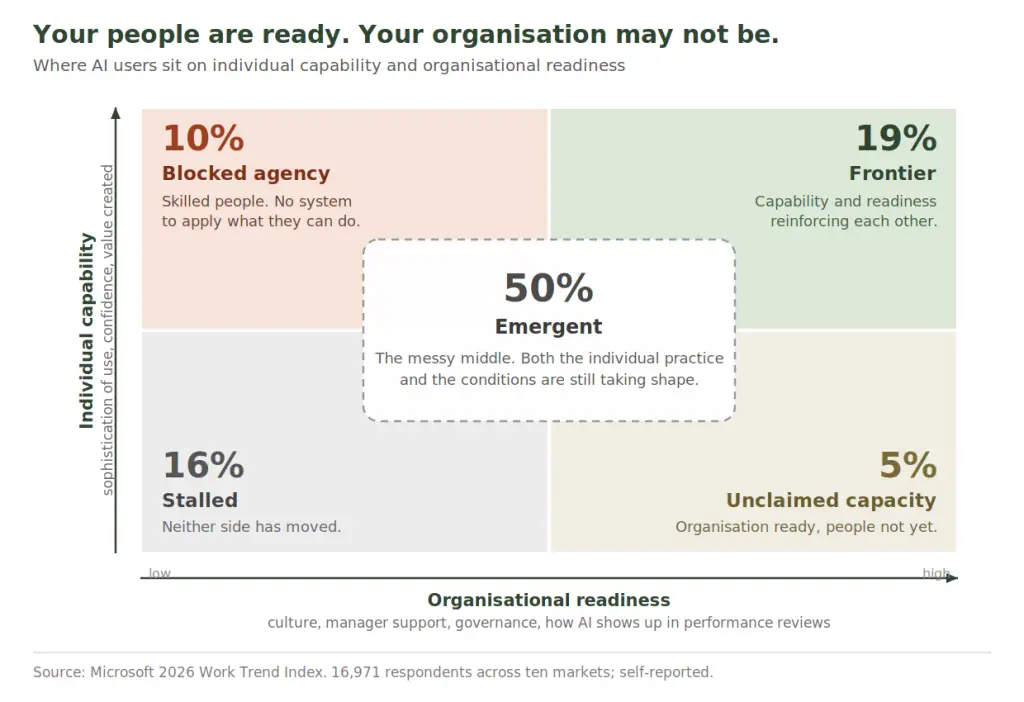
Figure 1. Only one in five AI users works in a company able to absorb what they can do. One in ten is skilled and stranded.
Read that carefully, because the implication runs against almost every AI programme currently in flight. Most organisations are investing in the 32%: training, licences, prompt libraries, tool rollouts. The 67% sits with leadership, and it is largely untouched.
The factories that bought electricity and got nothing
We have run this experiment before, at national scale, and the results are well documented.
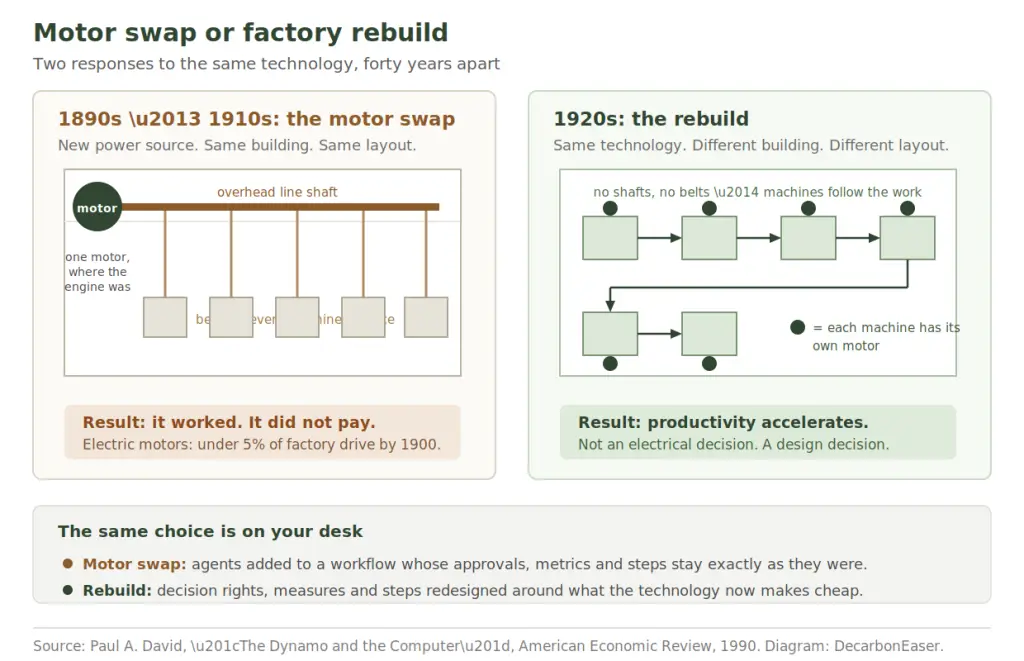
The lightbulb was patented in 1880. By the turn of the century, electric motors accounted for under 5% of factory mechanical drive in the United States. It took until the 1920s for that figure to approach half, and only then did manufacturing productivity accelerate. Forty years elapsed between a transformative technology arriving and the numbers moving.
The Stanford economist Paul David explained why in a 1990 paper that has aged extraordinarily well. The delay had nothing to do with the technology being immature or expensive. Factories had electrified, in a sense. What they had done was rip out the steam engine and drop a large electric motor in its place, leaving everything else untouched. The overhead line shafts stayed. The leather belts stayed. The multi-storey building, designed so that machines could cluster near the central power source, stayed.
It worked. It just did not pay. The gains were marginal, and for three decades a generation of industrialists could reasonably have concluded that electricity was overhyped.
The step change came when someone asked a different question. Not “how do we power this factory with electricity?” but “if every machine can have its own motor, what should a factory look like?” The answer was unit drive: a small motor on each machine, no shafts, no belts. Which meant machines could be positioned by the logic of the work rather than the geometry of the power source. Which meant single-storey buildings, laid out by process flow. Which meant natural light, overhead cranes, safer floors, and production lines that could be reconfigured in an afternoon rather than rebuilt over a summer.
None of that was an electrical decision. Every part of it was a decision about the design of work, and it sat with the people who ran the business, not the people who understood the technology.
Figure 2. The same technology, deployed two ways. Only one of them changed the numbers.
What the motor actually changed
Here is the part that matters for AI, and the part the electricity analogy usually misses when it is deployed as a plea for patience.
The electric motor’s decisive advantage was never that it was a better source of power. Steam was perfectly good power. The decisive advantage was that it decoupled power from location. Once energy could be delivered anywhere at negligible cost, the physical constraint that had dictated factory architecture for a century simply dissolved, and every layout choice built on top of that constraint became arbitrary.
AI is doing something structurally similar to a different constraint. It is decoupling expertise from position.
Look at what people actually use these tools for. A privacy-preserving analysis of over 100,000 Microsoft 365 Copilot conversations found that 49% support cognitive work: analysing information, solving problems, evaluating options, thinking creatively. Not drafting. Not summarising. Thinking. Two-thirds of surveyed users say AI lets them spend more time on high-value work, and 58% say they are producing work they could not have produced a year earlier.
Now ask what your organisation chart is actually for. Strip away the language of accountability and you find a routing system for scarce expertise. Hierarchies exist because judgement was rare and had to be concentrated. Approval gates exist because the people qualified to decide could not be everywhere. Specialist departments exist because deep knowledge could not be distributed. Handoffs, escalation paths, sign-off thresholds, centres of excellence: these are all solutions to the problem that expertise was expensive, slow and unevenly distributed.
Your organisation is a power-distribution diagram for a constraint that is loosening.
That is why adding agents to existing workflows produces such disappointing results. You are attaching unit-drive motors to a line shaft. Each one works. The building still cannot use them.
The paradox that keeps the system in place
If this is so obvious, why does nobody move?
The Microsoft data answers this with unusual precision, and the answer is not culture in the vague sense. It is arithmetic.
Sixty-five percent of AI users fear falling behind if they do not adapt quickly. Yet 45% say it feels safer to focus on current goals than to redesign how work is done. And only 13% say they are rewarded for reinventing work with AI when the results do not immediately land. Microsoft calls this the Transformation Paradox. I would put it more bluntly: you cannot ask people to redesign the work while continuing to pay them for the output of the old design.
Every rational employee in that situation makes the same calculation. Redesign carries a guaranteed short-term cost, an uncertain payoff and no upside if it fails. Hitting this quarter’s number the old way carries none of those risks. So people optimise locally, and the system holds.
Compounding this: only 26% of AI users say their leadership is clearly and consistently aligned on AI. And leaders consistently overestimate how safe experimentation feels. They were twice as likely as employees to say reinvention is rewarded regardless of outcome. From the top, the runway looks clear. From below, it does not exist.
Anyone who has worked on decarbonisation will recognise this exactly. It is the same reason a company can hold a public net-zero commitment while every procurement decision inside it is still made on lowest unit cost. The stated ambition and the operating incentives point in opposite directions, and the incentives win, quietly, every time.
The bolt-on tax
There is a second-order effect that few executive teams have priced in, and it is worse than a zero return.
Adding tools to an unredesigned system does not leave performance unchanged. It can degrade it. Research from BetterUp Labs and Stanford’s Social Media Lab, published in Harvard Business Review, surveyed 1,150 US desk workers and found that 40% had received “workslop” in the previous month: AI-generated material that looks finished but lacks the substance to move the task forward. Each incident cost the recipient an average of one hour and 56 minutes to resolve.
The mechanism is the point. Workslop is what happens when individual speed gains are introduced into a system with no shared quality bar, no defined handoff standard and no agreement on who owns the thinking. The sender saves twenty minutes. The receiver loses two hours. The saving is private and immediate; the cost is collective and delayed, which is precisely why it never appears in the business case.
Systems thinkers will recognise the shape. Local optimisation degrading global performance is one of the oldest failure modes we know, and it is the same logic as the rebound effect in energy efficiency: make each unit cheaper without changing the system it sits in, and the system finds a way to consume the saving.
Why this cannot be handed to IT
I want to be careful not to caricature technology teams, who are usually doing exactly what they have been asked to do. The problem is what they have been asked.
An IT function can build agents, integrate data, manage identity and permissions, and make the whole thing secure. All of that is necessary and none of it is trivial. Microsoft’s own framing is that IT becomes the control plane for agent operations, treating agents as managed entities with identities, permissions and lifecycle management. That is real work.
But an IT function cannot change what the organisation measures. It cannot alter who is allowed to approve what. It cannot redefine a role, retire a process, move a budget line, or change what counts as a good quarter. Those are the load-bearing walls, and they are all held by the executive team.
Handing AI to IT is asking the maintenance engineer to redesign the factory floor. He can wire every motor perfectly. He cannot move the walls, and he has no mandate to try.
McKinsey’s most recent global survey of nearly 2,000 organisations puts the consequence in financial terms. Around 88% report using AI in at least one function. Only about 6% qualify as high performers, defined as attributing more than 5% of EBIT to AI and reporting significant value. The distinguishing feature of that 6% is not their technology stack. It is that they have fundamentally redesigned workflows end to end and have senior leaders genuinely engaged, rather than sponsoring. McKinsey’s own conclusion, tested across twenty-five organisational attributes, was that workflow redesign has the single biggest effect on whether AI shows up in the bottom line.
Same finding, different dataset, different methodology.
A test you can run this week
Here is the diagnostic I now use with leadership teams, and it takes about ninety seconds per initiative.
Take any AI project currently underway in your organisation and ask three questions.
Does anything about who decides change? If the same person still approves the same thing at the same threshold, nothing structural has moved.
Does any metric change? Not a new AI dashboard. An existing performance measure that someone is judged on, redefined because the work is now done differently.
Does anything get retired? A step, a report, a meeting, a role as currently written, a control that existed only because a human was slow.
Three noes means you have a motor swap. The tool is real, the productivity is real, and the ceiling is low. You will get single-digit efficiency and a growing pile of workslop.
Most organisations, when they run this honestly across their portfolio, find that every single initiative is a motor swap. That is not a failure of ambition. It is what happens when the design authority sits with people who have no authority to redesign.
What honest scepticism should note
Three caveats, because this argument is easy to overstate.
First, the Microsoft data is self-reported survey data. The same respondent rated both their organisation and their own outcomes at the same moment, which means these are statistical associations rather than proven causes. Microsoft says so explicitly in its methodology. The 67/32 split is a directional signal, not a measurement, and it should not be load-bearing in a business case. It is consistent with independent research, which is why I find it credible, not because of the precision of the number.
Second, “redesign everything” is dangerous advice if taken literally. Large-scale transformation programmes have a poor track record, and the factories of the 1920s did not all rebuild at once. They rebuilt when they were building anyway. The practical version is to redesign at natural replacement points: the process you were about to re-platform, the function about to lose a third of its team to retirement, the new site, the acquired business, the system reaching end of life. Those are your greenfield moments, and there are more of them in any given year than most executives realise.
Third, and this is the uncomfortable one: physical factories eventually wear out and force a rebuild. Digital processes do not. A badly designed workflow can run for twenty years without ever producing a single event that compels anyone to look at it. There is no forcing function here. The redesign will happen only because someone with authority decides it should, which is exactly why it keeps not happening.
What to do differently
- Set the redesign mandate yourself, in the strategy, before any tooling decision. Name the specific workflows to be rebuilt rather than the tools to be deployed. Microsoft’s own guidance to leaders is that the job is to rearchitect work, deciding what humans and AI each do. That is a strategic act, not a technical one.
- Change one metric before you buy one licence. Pick a single function, identify the measure that currently punishes redesign, and change it. This is the highest-leverage move available to you, and it costs nothing.
- Create protected space where reinvention is rewarded regardless of outcome. Today only 13% of workers experience this. You cannot fix that everywhere at once, but you can designate a portfolio where it is explicitly true and say so publicly.
- Use the tools yourself, visibly. A separate Microsoft study of 1,800 workers found that when managers actively modelled AI use, employees reported a 17-point lift in perceived AI value and a 30-point lift in trust in agentic systems. Advanced users are far more likely to have a manager who openly uses AI, 85% against 64%. Delegated enthusiasm does not transmit. Observed practice does.
- Answer the three governance questions before you scale. Who reviews agent performance? Who has authority to update the workflows agents run? How does a local win become a shared standard? Organisations that cannot answer these will scale their mistakes faster than their gains.
- Build in deliberate friction. The most advanced users in Microsoft’s research are markedly more likely to pause before starting work to decide what should be done by a human versus AI, 53% against 33%, and more likely to do some work without AI deliberately to keep their own judgement sharp, 43% against 30%. This is a practice, and practices need to be designed into the working week or they do not happen.
The electricity story is usually told as a lesson in patience. I think that is the wrong reading, and a comfortable one. The forty-year lag was not a natural incubation period. It was thirty years of executives buying a transformative technology, bolting it onto a system built for something else, and quietly concluding it did not work, followed by a decade in which a smaller number of people asked a harder question and rebuilt around the answer.
The gap between those two groups was never technical. It was whether the person with authority over the design of the work understood that the design of the work was the thing that had to change.
That question is now on your desk. It is not on your CIO’s.